
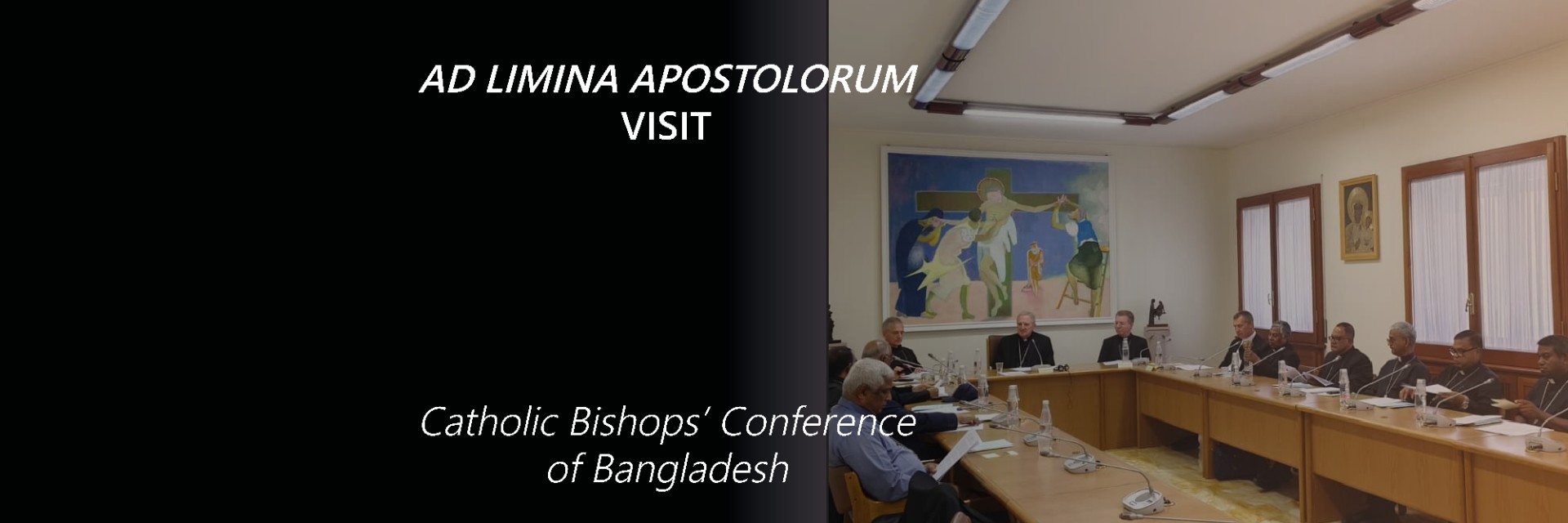
Ad Limina Visit of the Catholic Bishops' Conference of Bangladesh
During the meeting with the Bishops of the Catholic Bishops' Conference of Bangladesh, various topics concerning the liturgical life of the local Churches were discussed, highlighting both the pastoral challenges and the prospects for future development.
The Bishops first described the particular cultural and social context of the country, which does not always facilitate participation in the Church's liturgical life. In particular, it was noted that Sunday is ordinarily a working day, a circumstance that makes it more difficult for the faithful to participate in the Sunday Eucharistic celebration and calls for a sustained pastoral commitment to support the liturgical life of Christian communities. At the same time, the Bishops emphasized the faithful's strong appreciation for Sunday celebrations, which continue to be a fundamental point of reference for the life of their communities.
The activities of the National Liturgical Commission were then presented. In recent years, the Commission has developed several liturgical formation programs, directed especially to lay ministers, particularly readers and acolytes. These initiatives have been inspired also by the indications offered in Pope Francis' Apostolic Letter Desiderio desideravi, with the aim of fostering a deeper understanding of the liturgical celebration and promoting an ever more conscious, active, and fruitful participation of the faithful.
A significant portion of the discussion was devoted to the subject of liturgical translations. The Bishops emphasized that the translation of Sacred Scripture is fundamental for addressing and resolving questions related to the translation of the liturgical books. In this context, it was reported that work is currently underway on a new translation of the Roman Missal into the Bengali language. Given that Bengali is spoken beyond the borders of Bangladesh, the possibility of collaboration with other Episcopal Conferences that use the same language was considered, with a view to promoting a common effort and ensuring greater quality and consistency in the translations.
The Bishops also highlighted the economic difficulties that significantly affect the publication and distribution of liturgical books. Added to this is the complex issue of the country's minority languages, for which it is necessary to establish appropriate pastoral and linguistic criteria to determine when and how liturgical books should be translated, taking into account the actual needs of the ecclesial communities and the resources available.
Finally, the Bishops expressed a clear awareness of the delicate question of liturgical inculturation. While recognizing its importance for the work of evangelization, they reaffirmed the need to avoid misunderstandings or arbitrary interpretations of the principle of inculturation, so that any adaptation of the liturgy may always be carried out in fidelity to the Church's tradition, the liturgical norms in force, and the proper nature of the sacred liturgy.