
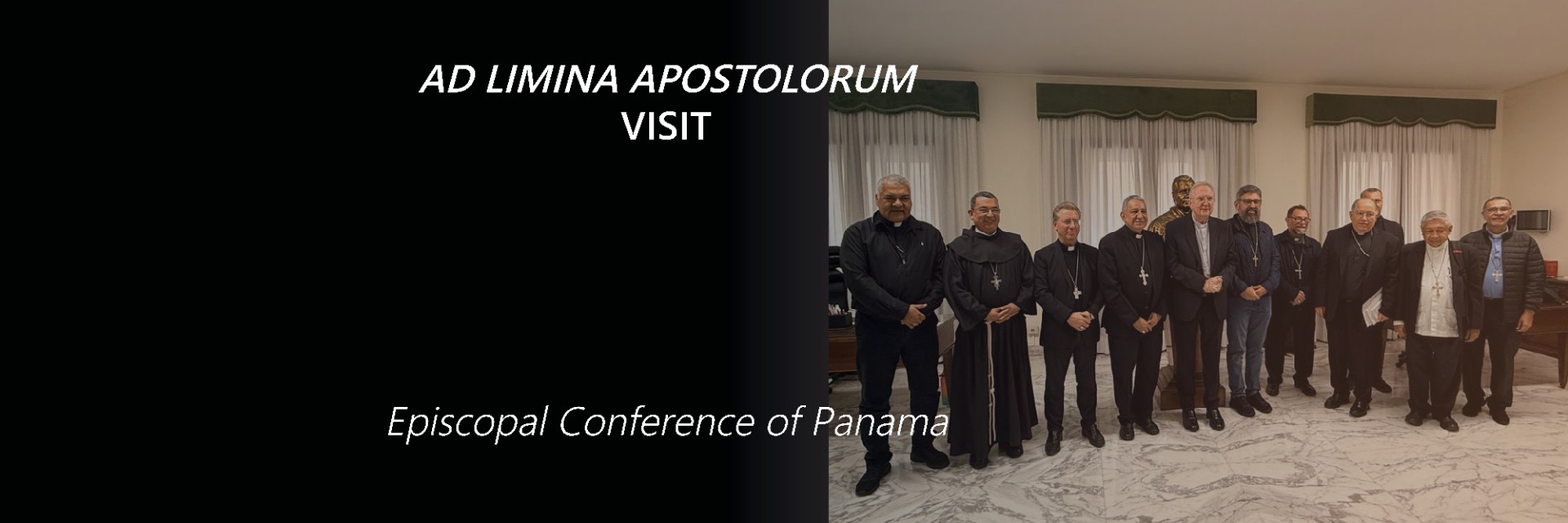
Ad Limina Visit of the Episcopal Conference of Panama
On 21 October 2026, the Bishops of the Episcopal Conference of Panama were received at the Dicastery for Divine Worship and the Discipline of the Sacraments on the occasion of their ad limina Apostolorum visit.
During the meeting, some aspects of the liturgical and pastoral life of the Church in Panama were shared. Among the topics addressed were Sunday celebrations in the absence of a priest and the role of the "Delegados de la Palabra (delegates of the Word)". This is a reality that requires particular attention, so that communities may live the Lord’s Day while preserving a sense of ecclesial communion and of the liturgical assembly.
Part of the discussion was devoted to the programs of preparation for the Sacraments of Marriage and Reconciliation. The need was emphasized to prevent any instrumentalization of the sacraments: in the case of Marriage, a certain commercial logic; in the case of Reconciliation, individualism and a tendency towards psychologizing the sacrament, which risk obscuring its nature as an encounter of the penitent with the Father of Mercies.
The Bishops also stressed the importance of formation, particularly in relation to the parallel information circulating through blogs and opinions of various kinds, acknowledging the difficulty of developing adequate formation programs. In this context, the value of the directory of liturgical pastoral care was recalled, as a tool for preserving uniformity in celebration and thus expressing ecclesial unity.
The discussion then turned to liturgical singing, which must be authentically in keeping with the criteria of sacred music, without expressing individualism, mere emotionalism, or local folklore. The need was also recalled for the texts of hymns to contain doctrinally sound content, free of concepts borrowed from other religions.
The Dicastery addressed the question of the Missal and other liturgical books with the Bishops, providing guidance on the paths and procedures foreseen in the event that the Episcopal Conference of Panama wishes to adopt translations already approved by other Episcopal Conferences.
The dialogue also brought to light the danger of extremism in the liturgical sphere and of the instrumentalization of the Eucharistic celebration by certain groups of the faithful. These groups tend to provoke division and confusion by raising issues such as receiving Communion kneeling and in the hand, or the use of the veil by women. It was reaffirmed that the Eucharist is the sacrament of unity and cannot become an object of contention.
The Bishops reported certain incorrect practices in Eucharistic adoration, which risks becoming a highly individual form of worship, detached from the celebration of the Eucharist. They also noted a tendency to expand the celebration by inserting gestures, prayers, and responses that compromise the sobriety proper to the Roman Rite.